
If you’re searching for the best pet insurance for dogs, the biggest mistake is choosing a policy based only on its monthly price.
A cheaper plan can have a lower annual limit, higher out-of-pocket costs, or exclusions that matter when your dog actually needs treatment.
The better approach is to compare coverage, deductibles, reimbursement rates, annual limits, waiting periods, exclusions, and claim procedures together.
This guide compares 10 well-known pet insurance options, explains what to look for, and highlights which types of dog owners each option may suit best.
Because coverage and availability can change by state, province, country, and policy, always check the current policy documents before enrolling.
Quick Answer: What Is the Best Pet Insurance for Dogs?

There isn’t one best dog insurance plan for every pet owner. The right choice depends on your dog’s age, breed, location, health history, budget, and how much financial protection you want.
For U.S. dog owners, these 10 providers are worth comparing:
1. Spot — Strong overall coverage and customization
2. ASPCA Pet Health Insurance — Broad coverage options
3. Pumpkin — Comprehensive coverage features
4. MetLife Pet Insurance — Highly customizable plans
5. Figo — Flexible reimbursement and unlimited-benefit options
6. Pets Best — Budget-friendly customization
7. Embrace — Flexible annual limits and reimbursement choices
8. Fetch — Broad coverage for dogs
9. Trupanion — Strong option for major, long-term veterinary expenses
10. Lemonade — Digital-first experience and customizable options
These aren’t universal rankings. A plan that works well for a young Labrador may not be the best choice for an older French Bulldog or a dog with a complex medical history.
10 Best Pet Insurance Plans for Dogs Compared

1. Spot Pet Insurance
is a strong option for dog owners who want to customize their coverage.
Spot says its plans can offer 70%, 80%, or 90% reimbursement, with annual deductibles and annual limits that can be customized. Its current options include annual limits up to $10,000 or unlimited coverage, depending on the plan.
One useful feature is the annual deductible. Rather than having a deductible reset for every incident, Spot describes its deductible as applying once during a policy year.
Best for: Dog owners who want flexibility when balancing premiums, deductibles, reimbursement, and annual limits.
Potential drawback: The most comprehensive configuration may cost considerably more than a lower-limit plan.
2. ASPCA Pet Health Insurance
offers accident and illness coverage with options that can include hereditary conditions, alternative therapies, and behavioral conditions.
Its Complete Coverage plan allows customers to customize the annual deductible, annual limit, and reimbursement percentage.
ASPCA also provides an app for submitting and tracking claims, which can make managing paperwork easier.
Best for: Owners looking for broad coverage and customizable policy parameters.
Potential drawback: The right combination of limits and reimbursement can make premiums higher than a basic policy.
3. Pumpkin Pet Insurance
is another option for owners looking for relatively broad accident-and-illness protection.
Pumpkin’s policy disclosures explain that eligible expenses are reimbursed after the applicable deductible and reimbursement percentage are applied, subject to the annual policy limit.
As with other insurers, the actual value of a Pumpkin policy depends heavily on the coverage configuration and the policy terms applicable to your location.
Best for: Dog owners who prioritize comprehensive accident-and-illness protection.
Potential drawback: Premiums can vary significantly according to factors such as the dog, location, and selected coverage.
4. MetLife Pet Insurance
stands out for policy customization.
MetLife currently describes reimbursement options from 50% to 90%, deductible choices ranging from $0 upward, and annual benefit limits from $500 to $25,000, with an unlimited option also available.
It also offers an optional Preventive Care plan for routine expenses such as vaccinations, parasite prevention, dental cleaning, and spaying or neutering, subject to the plan’s benefit limits.
Best for: Owners who want to adjust coverage around a specific budget.
Potential drawback: More customization means you need to understand exactly what you’re selecting.
5. Figo Pet Insurance
offers flexible plans for unexpected illnesses and injuries.
Figo says its options include reimbursement of up to 100%, an unlimited annual-benefit option, and no per-incident cap on claims. It also advertises a wellness plan and 24/7 access to licensed veterinary professionals.
Another potentially useful feature is Figo’s treatment of some curable pre-existing conditions. Its current information says certain curable conditions may become eligible if the pet has shown no signs or symptoms for 12 months after the last treatment.
Best for: Owners seeking high reimbursement flexibility and an unlimited-benefit option.
Potential drawback: Eligibility and exact policy terms need to be checked for your location.
6. Pets Best
is worth considering if affordability and customization are important.
Pets Best currently lists reimbursement options from 70% to 90% and annual deductible choices from $100 to $1,000.
Its dog insurance information also makes clear that routine and preventive care generally isn’t included in its standard accident-and-illness coverage unless a wellness plan is added. Pre-existing conditions and several elective, breeding-related, and other expenses are excluded.
Best for: Budget-conscious owners who still want to customize coverage.
Potential drawback: A lower premium can mean accepting coverage limitations, so compare the policy rather than the monthly price alone.
7. Embrace Pet Insurance
offers several ways to customize a dog’s coverage.
Its current dog insurance information lists annual limits from $2,000 to unlimited, deductibles from $200 to $1,000, and reimbursement rates of 70%, 80%, or 90%.
Embrace also explains that its deductible is annual, meaning you generally satisfy one deductible per pet per policy year rather than a separate deductible for every incident.
Best for: Owners who want to customize annual limits, deductibles, and reimbursement.
Potential drawback: Routine wellness care isn’t included in the standard accident-and-illness policy.
8. Fetch Pet Insurance
focuses specifically on dog and cat insurance and highlights a broad range of covered services.
Fetch says its dog coverage includes sick-visit exam fees and coverage for every tooth and gums up to the policy maximum. It also advertises benefits for behavioral therapy and online veterinary visits under specified terms.
Its coverage comparisons also highlight prescription-related benefits and other services that may not be included in every competing policy.
Best for: Owners who place a high value on broad dog-related benefits.
Potential drawback: Always compare the actual policy limit and exclusions rather than relying on a list of headline benefits.
9. Trupanion
takes a different approach from many traditional reimbursement-based dog insurance plans.
Trupanion describes 90% coverage for eligible new illnesses and injuries and unlimited payouts for covered conditions. Its distinctive feature is a per-condition deductible rather than an annual deductible. Once that deductible has been satisfied for a qualifying condition, it does not reset for that same condition.
Trupanion also offers VetDirect Pay, which can allow the company to pay participating veterinarians directly rather than requiring the pet owner to pay the entire bill first. Availability depends on the veterinary practice.
Best for: Owners particularly concerned about expensive or recurring conditions.
Potential drawback: Its structure can be less intuitive than an annual-deductible policy, and premiums may be higher than some alternatives.
10. Lemonade Pet Insurance
is designed around a digital-first insurance experience.
Its current pet insurance information describes coverage for diagnostics, procedures, hospitalization, surgery, and prescription medication for covered new accidents and illnesses. Optional preventive-care packages can cover certain routine expenses.
Lemonade also explains that pet insurance is generally reimbursement-based: you pay the veterinary bill, submit a claim through the app, and receive reimbursement for an approved claim according to your policy.
Waiting periods vary by policy and location. Lemonade currently lists examples including accident, illness, orthopedic, and cruciate-ligament waiting periods.
Best for: Dog owners who prefer a technology-focused claims and policy-management experience.
Potential drawback: Availability and exact coverage vary by state.
What Does Pet Insurance Usually Cover?
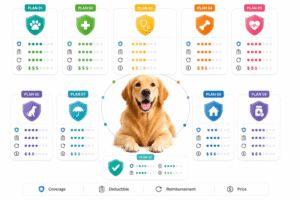
Pet insurance for dogs generally focuses on unexpected accidents and illnesses rather than ordinary preventive care.
Depending on the policy, covered expenses can include:
– Emergency veterinary treatment
– Surgery
– Hospitalization
– Diagnostic testing
– X-rays
– Ultrasounds
– CT scans or MRIs
– Prescription medications
– Specialist treatment
– Treatment for covered hereditary or congenital conditions
– Some dental conditions
– Some alternative or behavioral therapies
For example, MetLife describes accident-and-illness coverage for eligible costs after applicable waiting periods, while Fetch and ASPCA list additional benefits that may be available under their policies.
However, coverage varies by insurer and policy. A treatment being covered by one provider doesn’t mean it will automatically be covered by another.
What Does Pet Insurance Usually Not Cover?
Common exclusions can include:
– Pre-existing conditions
– Treatment during applicable waiting periods
– Routine vaccinations under standard accident-and-illness plans
– Routine grooming
– Elective or cosmetic procedures
– Breeding-related expenses
– Some dental treatments
– Certain behavioral services
– Expenses specifically excluded by the policy
Pets Best, for example, excludes pre-existing conditions and routine preventive care from its standard coverage unless an appropriate wellness plan is added.
The important point is that there is no universal exclusion list. Read the policy wording, definitions, limitations, and exclusions before buying.
How Much Does Pet Insurance for Dogs Cost?
The cost of dog pet insurance varies substantially.
Factors that can affect your premium include:
– Your dog’s age
– Breed
– Location
– Size
– Coverage level
– Deductible
– Reimbursement percentage
– Annual limit
– Policy type
– Insurer
– Optional wellness coverage
A $5,000 annual limit with a high deductible can cost much less than an unlimited policy with a low deductible and high reimbursement percentage.
For example, MetLife currently shows example plans where changing the annual benefit and deductible changes the advertised monthly price. These are examples rather than universal prices, and actual quotes depend on the individual pet and location.
The best way to estimate your dog insurance cost is to obtain quotes using your actual dog’s age, breed, location, and desired coverage.
Understanding Deductibles, Reimbursement and Annual Limits
These three numbers are among the most important parts of a dog insurance policy.
Deductible
The deductible is the amount you pay before the insurer begins reimbursing eligible expenses.
For example, suppose you have:
– $500 deductible
– 80% reimbursement
– $10,000 annual limit
If an eligible claim is $3,000 and the deductible is subtracted first, $2,500 remains. At 80%, the potential reimbursement would be $2,000, assuming the entire expense is eligible.
MetLife uses this type of calculation in its examples.
Reimbursement Percentage
This is the percentage of eligible expenses the insurer pays after the applicable deductible.
Common options include 70%, 80%, and 90%, although some insurers offer other choices.
Annual Limit
The annual limit is the maximum amount the insurer will reimburse during the policy year.
Once that limit is reached, additional eligible expenses generally become your responsibility until the policy’s coverage period resets.
Dog Insurance With Wellness Coverage: Is It Worth It?

Wellness coverage is different from traditional accident-and-illness insurance.
A wellness or preventive-care package may reimburse some routine expenses such as:
– Annual wellness exams
– Vaccinations
– Parasite prevention
– Certain screening tests
– Dental cleaning
– Spaying or neutering
– Microchipping
However, wellness benefits usually have their own reimbursement limits and rules.
MetLife, for example, offers an optional Preventive Care plan for certain routine expenses, while Lemonade offers preventive-care packages with specific benefits and limits.
Before adding wellness coverage, estimate what you normally spend on routine care. The goal isn’t simply to get more benefits; it’s to determine whether the additional premium makes sense for your dog’s expected needs.
How to Choose Pet Insurance for Dogs
Use this simple process when comparing policies.
1. Start With Your Worst-Case Risk
Ask yourself how you would handle a $5,000, $10,000, or larger veterinary bill.
If a major emergency would seriously affect your finances, stronger coverage may be more valuable than a very low premium.
2. Compare Annual Limits
A low annual limit can leave you exposed during a year involving cancer treatment, major surgery, or several unrelated illnesses.
Unlimited coverage isn’t automatically necessary, but it can provide greater protection against unusually high veterinary expenses.
3. Check the Deductible
A higher deductible can reduce the premium, but you need enough savings to comfortably pay it when a claim occurs.
4. Compare Reimbursement Rates
An 80% policy and a 90% policy can produce very different out-of-pocket costs on large eligible claims.
5. Read the Exclusions
Don’t stop at the list of covered treatments. The exclusions section can be equally important.
6. Check Waiting Periods
A condition that occurs during a waiting period may not qualify for reimbursement.
7. Understand Pre-Existing Condition Rules
Most traditional pet insurance policies don’t cover conditions that existed before coverage began, although definitions and exceptions can differ.
8. Check the Claim Process
Find out whether you must pay the veterinarian first or whether the insurer offers direct payment arrangements.
9. Review Renewal Terms
Premiums can change over time. Read the renewal provisions and understand how age, location, claims history, or other factors can affect your policy.
10. Compare the Actual Policy
A quote is only part of the decision. The policy wording determines what is actually covered.
USA vs. UK, Canada and Europe
One of the most important points for international readers is that pet insurance isn’t structured identically across countries.
United States
The 10 providers compared above are primarily U.S.-focused options. U.S. policies commonly use terms such as:
– Deductible
– Reimbursement percentage
– Annual limit
– Waiting period
– Accident-and-illness coverage
– Wellness or preventive-care coverage
Availability can differ by state, and the policy form can affect exclusions and benefits.
United Kingdom
The UK market uses several policy structures that aren’t identical to the typical U.S. model.
The Association of British Insurers identifies major types including lifetime, maximum benefit, time-limited, and accident-only policies.
A lifetime policy can restore the available benefit when the policy renews, while a maximum-benefit policy can stop covering a particular condition once its financial limit is exhausted. Time-limited policies generally restrict coverage for a condition to a specified period, often 12 months.
The UK government also advises pet owners to compare policies carefully because coverage, claim limits, and duration can vary.
Canada
Canadian pet owners should compare policies available in their province or territory rather than assuming a U.S. plan is available or suitable.
Canada’s Financial Consumer Agency recommends shopping around, comparing coverage and cost, checking what is and isn’t covered, and reading the policy carefully before signing. Insurance regulation can also involve provincial and territorial regulators.
Europe
Europe should not be treated as one single pet insurance market.
Insurance products, regulation, currencies, availability, reimbursement structures, and consumer protections can differ between countries. If you’re in France, Germany, Spain, Italy, the Netherlands, or another European country, compare providers licensed and available in that specific market.
Pros and Cons of Pet Insurance

Pros
– Helps reduce the financial impact of unexpected veterinary bills.
– Can make expensive treatment easier to afford.
– Allows you to choose coverage around your budget.
– May cover emergencies, surgery, diagnostics, medications, and specialist care.
– Some policies offer optional wellness benefits.
– Strong policies can provide protection against very expensive illnesses.
Cons
– Monthly premiums can become expensive.
– Deductibles and reimbursement rules mean you still pay part of covered costs.
– Pre-existing conditions are commonly excluded.
– Waiting periods can apply.
– Annual limits can restrict reimbursements.
– Routine care may require an additional wellness plan.
– Premiums and policy terms can change over time.
Common Pet Insurance Mistakes to Avoid
Choosing Only by Price
The cheapest premium isn’t necessarily the cheapest policy when you need treatment.
Ignoring Annual Limits
A policy with a low annual limit may leave you exposed after a major claim.
Not Reading Exclusions
Always che